
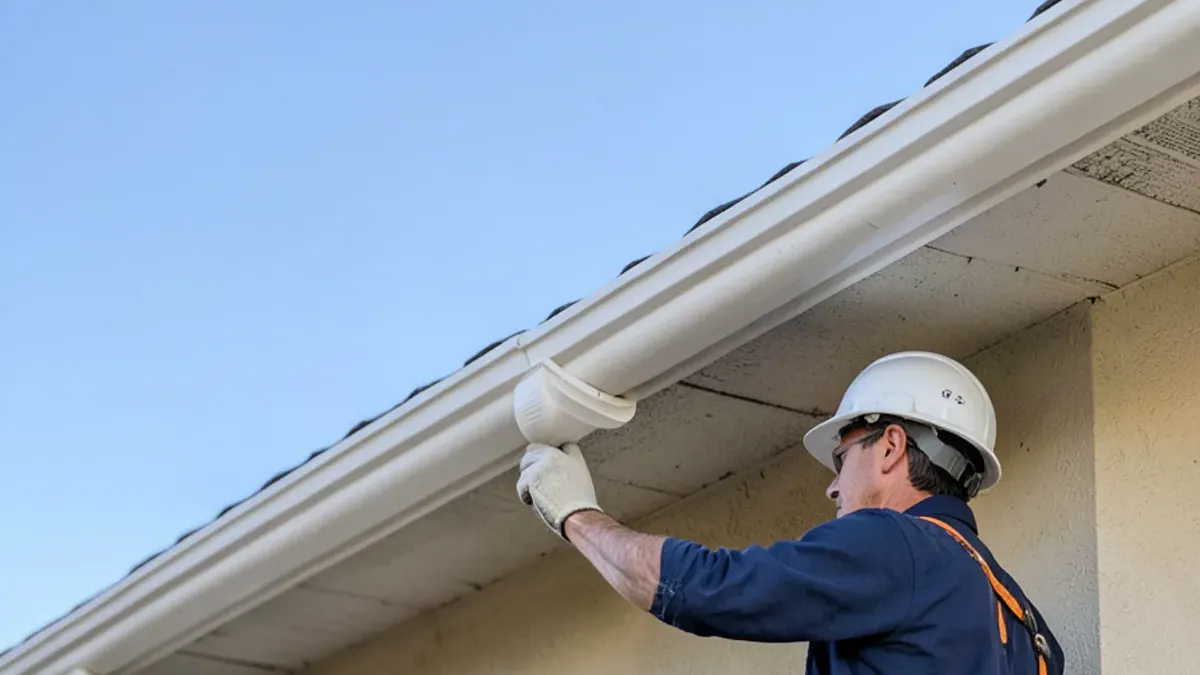
Which should you buy, seamless or sectional gutters?
Buy seamless in most cases, because it has fewer joints to leak. Choose sectional when the run is short, the budget is tight or access makes a long continuous piece impractical.
Seamless gutters are formed on site from a coil to the length of each wall, so a straight run has no joints along it. Sectional gutters come in short lengths, commonly around 10 feet, and are joined with connectors and sealant. Every joint is a place for the sealant to dry out, shift or collect leaves.
| Seamless | Sectional | |
|---|---|---|
| Joints | Only at corners and downspouts | Every section |
| Leak risk | Lower on straight runs | Higher at each joint |
| Debris catch | Fewer snags | Joints can snag |
| Repair | Replace a run or re-seal a corner | Replace one section |
| Fit | Cut to the wall | Standard lengths |
| Cost | Higher | Often lower per foot |
How do they compare on leaks and repairs?
Leaks start at joints. A seamless run keeps them to corners and downspout outlets, and sectional runs add one every length. That is why seamless leaks less over time, as long as the corners are sealed well.
Repairs go the other way. A sectional gutter can be fixed by swapping one section, while a seamless run is cut to length, so a bad stretch usually means a new piece or a re-sealed corner. Neither is hard to maintain if the downspouts are clear, and the gutter installation page shows how runs are laid out.
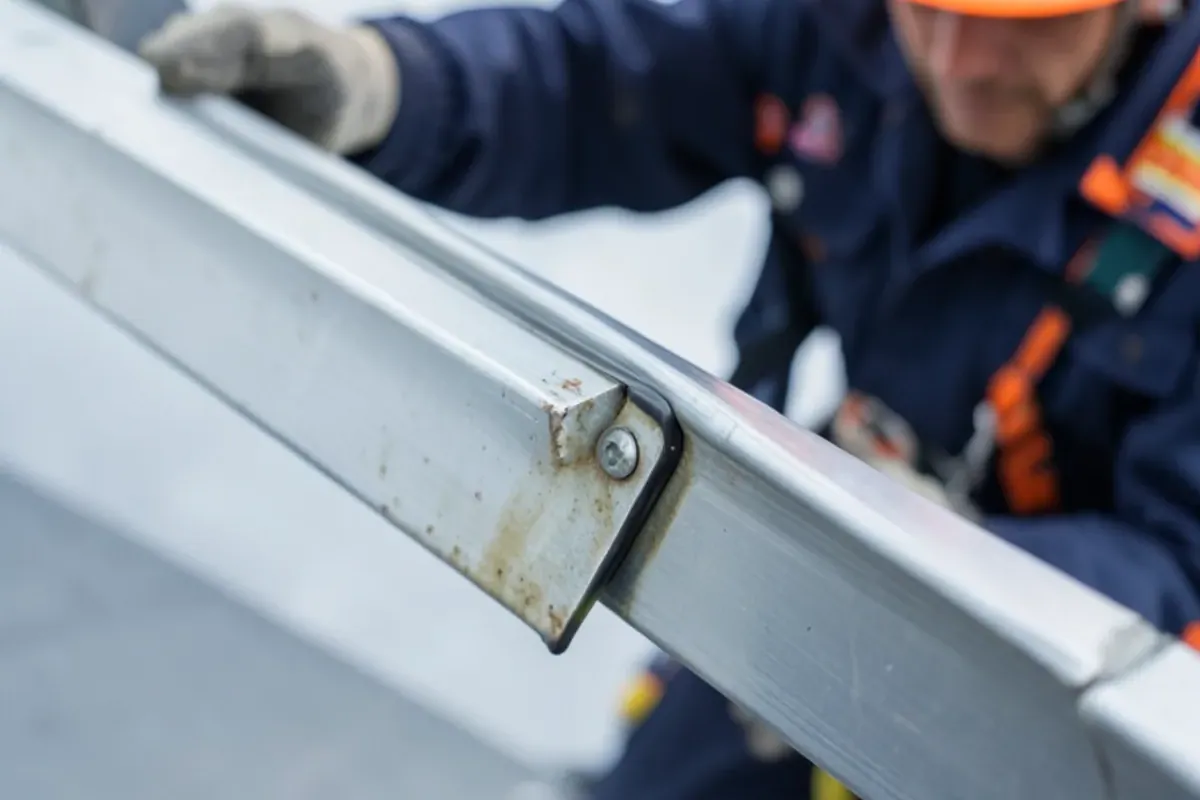
Which material is better, aluminum or steel?
Aluminum is the common residential choice, since it does not rust. Steel is stronger and can handle heavier loads and dents better, but coatings matter and scratches can rust. Copper costs the most and is a design choice. Match the material to how you use the roof, where trees overhang and how long you intend to keep the house.
Color and finish also matter: a baked-on finish should be listed in the bid. If you have a bay-side home, ask the installer which finish handles salt air.
When do deeper gutters or half-round make sense?
Choose a deeper gutter when the roof area is large, the pitch is steep or heavy rain overwhelms a standard trough. A bigger profile and more downspouts both help. Half-round suits older homes where a rounded trough matches the trim, though it may need different hangers and can cost more.
On older Alameda houses, exterior changes can trigger City of Alameda Planning design review in addition to a permit, so ask the Permit Center before changing the look of a historic home. A swap of like for like rarely changes the look.
What size gutter does your roof need?
Size the gutter to the roof area that drains into it, not to the square footage of the house. Gutter guides commonly pair a 5-inch K-style gutter with a 2 by 3 inch downspout and a 6-inch gutter with a 3 by 4 inch downspout. Published capacity tables disagree with each other because they assume different rainfall rates, so ask the installer to show the sizing logic, not just a number.
Use this order when you size a run:
- Find the roof sections that drain to each gutter, and note any valley that dumps into one corner
- Note the pitch, since steeper roofs shed water faster
- Pick the gutter profile, then match the downspout size and count to it
- Check that a long run has a downspout near each end or a slope toward a center outlet
- Confirm where each downspout lands and where the water goes after it
A six-inch gutter feeding one small downspout is still limited by the downspout. In Alameda, about 22 inches of rain falls a year, almost all of it October through April (BestPlaces), so the whole system is tested over a few wet months and a weak outlet shows itself in the first big storm. Valleys and large upper roofs that spill onto lower roofs are the places where a deeper gutter earns its cost.
Where do seamless gutters still leak?
A seamless run has fewer joints, not none. Leaks cluster at the places that remain.
- Mitered inside and outside corners, where two pieces meet
- End caps at the far end of each run
- Downspout outlets, where the trough is cut for the drop
- Hanger spacing that lets the trough sag and hold water
- The fascia side, where a gap lets water run behind the gutter
When a corner weeps, the fix is usually to clean and reseal it, not replace the run. The gutter repair page covers what a corner or outlet repair involves. Ask the installer to run water through a new run before the crew leaves, and watch the corners and outlets.
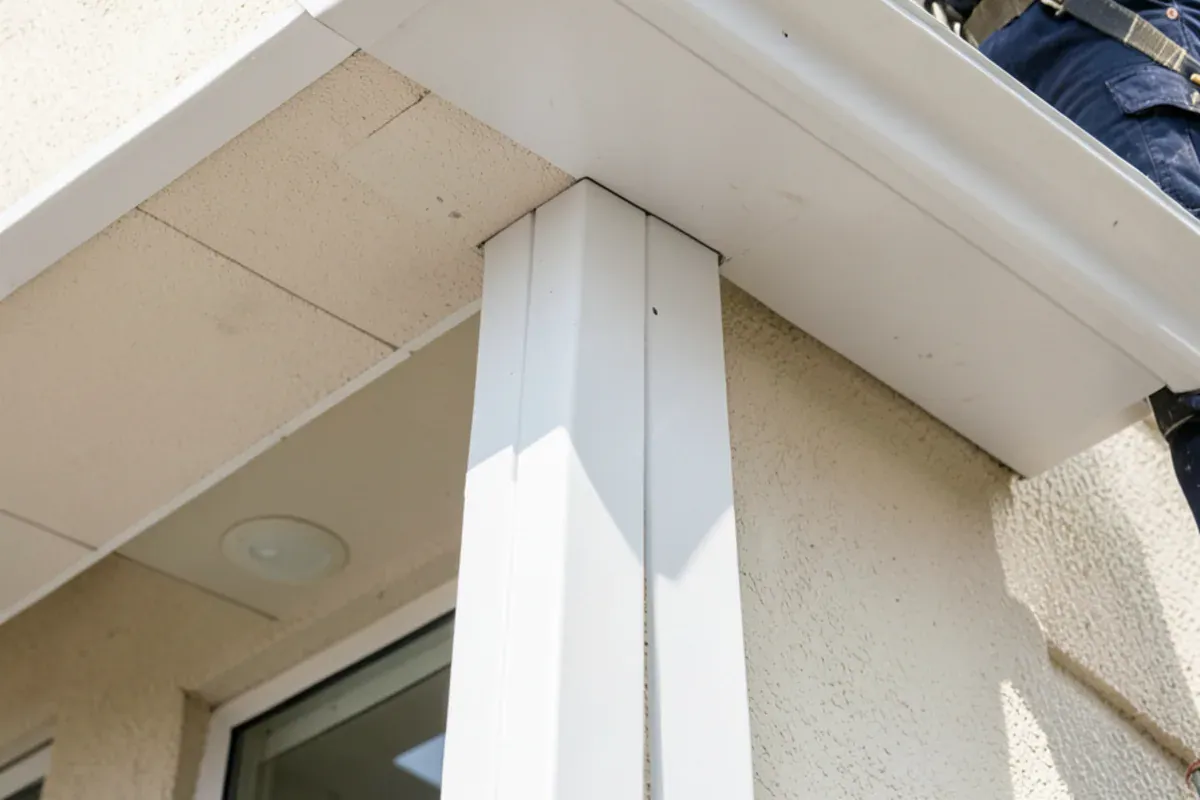
How do you choose gutters and downspouts?
Work through the roof first. A few questions settle it:
- How much roof area drains to each run?
- Where do the downspouts land, and where does the water go after?
- How close are trees, and do you want guards later?
- Is the fascia sound, or does it need repair first?
- Do corners, bays and long straight runs fit seamless lengths?
Fascia matters because new gutters hung on soft wood fail early; the fascia and soffit repair page explains how rotted boards are handled before the new run goes up. Roofline trim, soffits, fascia and gutters were replaced together on one Alameda ranch home, which is a common pairing.
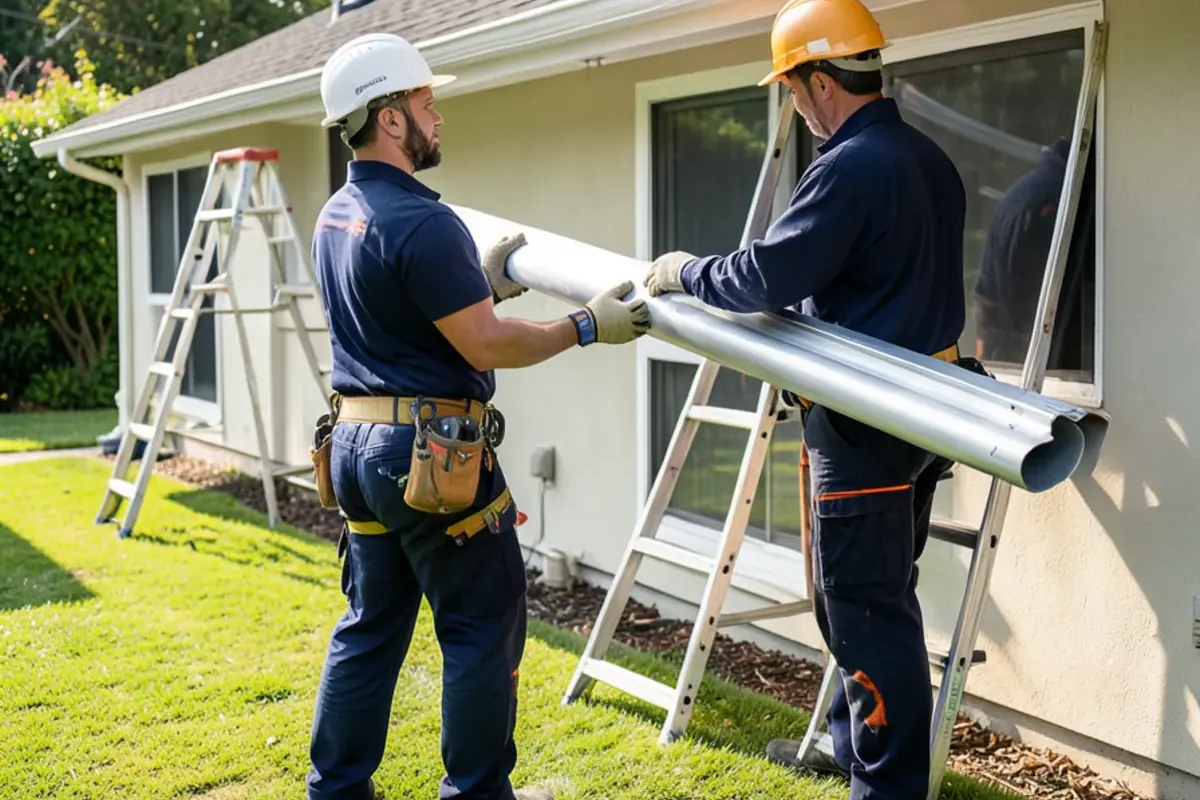
What should a gutter bid include?
A useful bid is specific. Look for these lines:
- Material, thickness and finish, named exactly
- Profile and size, such as the trough shape and depth
- Linear feet, number of corners and number of downspouts
- Removal and disposal of the old gutters
- Fascia checks and who pays if boards are soft
- Splash blocks or downspout extensions to carry water away
- Cleanup and the final walkthrough
Keep the bids side by side and compare line for line. A low price that leaves out downspouts or fascia work is not lower.
How do you keep new gutters working?
Seamless or sectional, a gutter fails when it clogs. Clear it at least twice a year, flush the downspouts and look for sag. After a storm, check that water leaves the splash area and moves away from the foundation. A pulled bracket or a sagging run is a quick fix now and a rotted fascia later, so do not leave it.
What we see on gutter jobs
In Alameda, gutters have been installed after a reroof so the roofline and the drainage are finished together. One owner of three rental homes had gutter work across all three, and a whole-house deeper gutter run went on another home. The practical lesson is that gutter and roof edge belong in one conversation.
The overall cost depends on length, corners, downspouts, height and material. Hold the installer to a written estimate, and make sure it lists the gauge, the finish and the number of downspouts. If you want a bid on gutters, call us or ask for a free estimate, and see the wider gutters overview for options.