
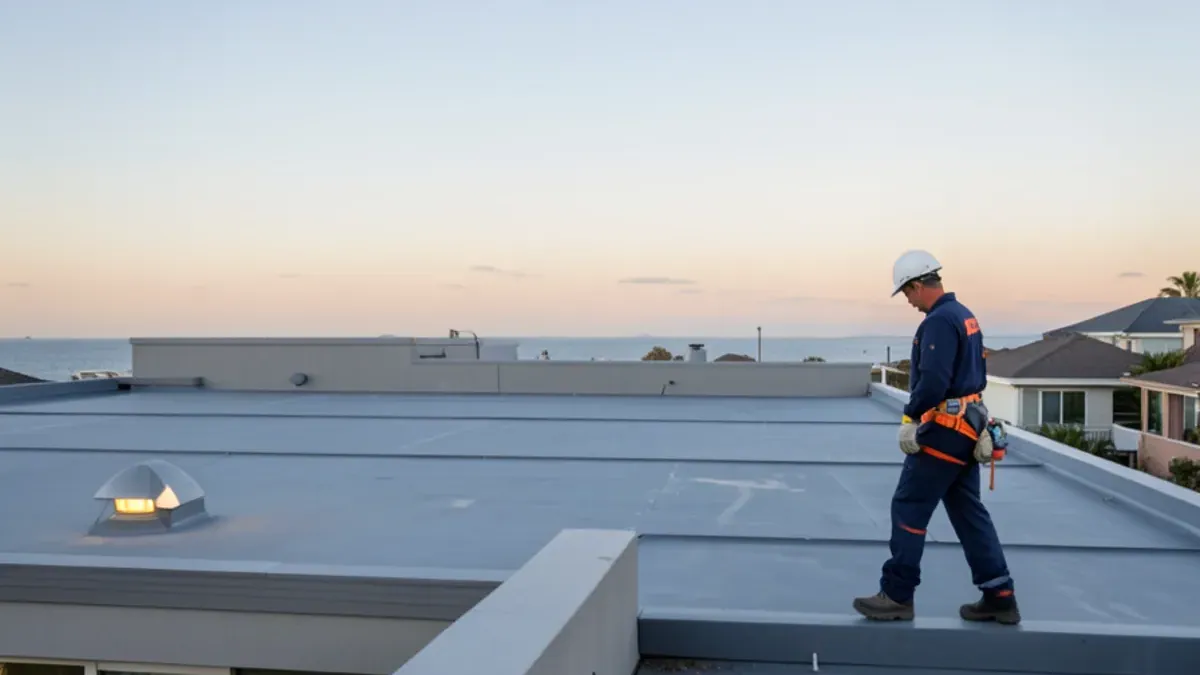
What does a flat roof need between inspections?
A flat roof needs clear drains, a look at the seams and flashing, and a record of any water that lingers. Do those three things twice a year, in spring and fall, and most leaks show up as small, cheap problems first. Skip them and the first sign is usually a ceiling stain, long after the membrane has started to fail.
NRCA recommends inspecting roof systems at least twice a year, ideally spring and fall, and after severe weather. It points owners to the places debris collects: valleys, gutters and roof drains, where leaves can restrict drainage. On a flat roof that is the whole game, because water leaves only through a drain, a scupper or an edge.
How do you clean roof drains and scuppers?
Keep the strainer, the drain bowl and the outlet open. Lift off leaves, grit and any loose gravel by hand, then pour a bucket of water at the drain and watch it go. If it backs up, the line below is blocked, and that is a plumber or roofer call, not a push-harder-with-a-hose call.
- Remove debris by hand, wearing gloves.
- Do not use a sharp tool near the membrane.
- Check that the strainer is still attached and not cracked.
- Clear overflow scuppers and gutters at the parapet too.
- Photograph each drain after cleaning so you have a baseline.
Do this after leaf drop, after windy weather, and before the rains. Alameda gets about 22 inches a year, almost all of it October through April (BestPlaces), so the dry months are when you make sure nothing is waiting to clog.

What should you look for on membrane seams and flashing?
Look for the places where one piece of roof meets another. Membranes fail at seams, corners, penetrations and where they climb a wall far more often than in the open field.
- Seams: open edges, lifting laps, bubbles along a weld or lap line.
- Flashing: cracked sealant, gaps at the parapet, pipe collars with splits.
- Surface: blisters, punctures, alligator-style cracking, worn patches at foot paths.
- Skylight and vent curbs: dried or shrunken sealant at the base.
- Edges: loose metal trim or exposed membrane at the perimeter.
Take close photos from the same spot each time. A change between visits is more telling than any single picture. Repair a small gap quickly; a flat roof repair caught early is a patch, and one caught late can be a section of wet insulation.
Is ponding water a problem?
Water that is still standing well after the rain has stopped is worth tracking. A shallow wet patch that dries within a day is common on a nearly level surface. A deep or permanent pool means the roof deck has dipped, a drain sits too high, or debris is holding it back, and every extra day of soak works on the seams.
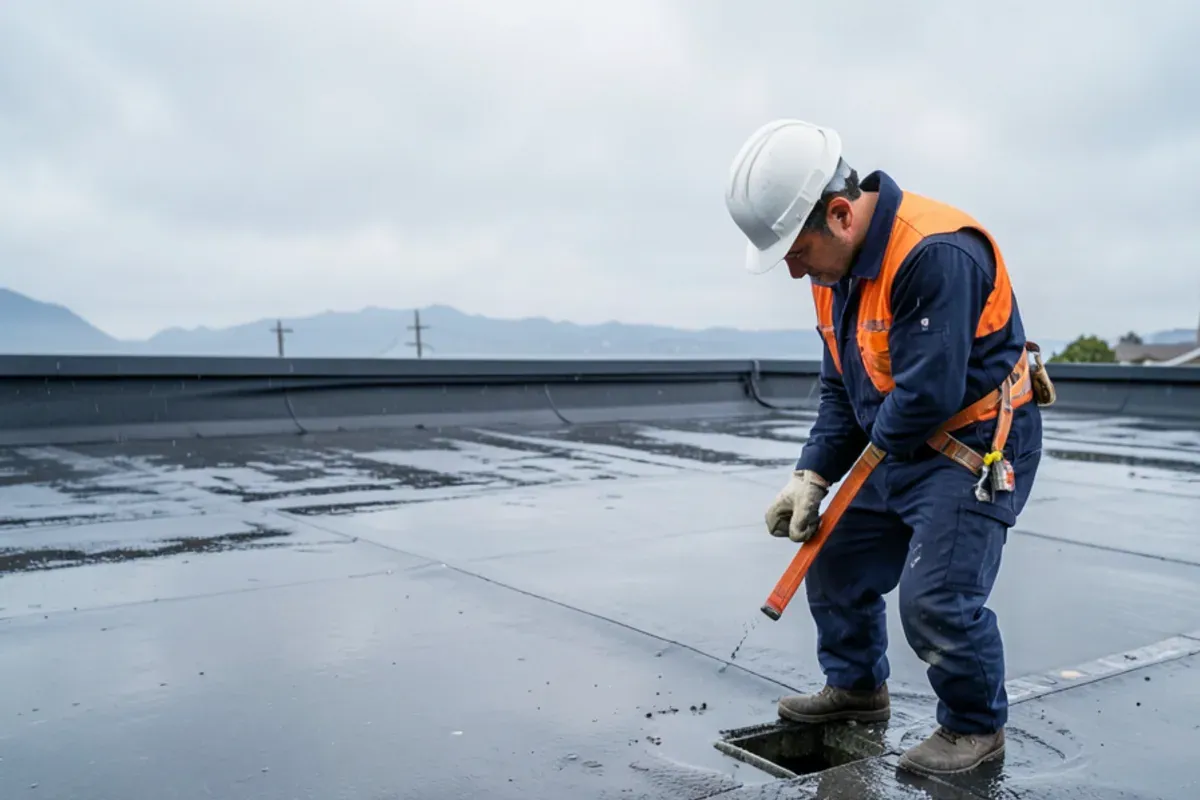
The NRCA glossary defines ponding as water that stays in low spots more than 48 hours after rain, under conditions that allow drying. Use that as your yardstick: a puddle that is gone in a day is normal, and one that is still there on the third morning is a finding to write down.
Mark the edge of each puddle with a photo or chalk line and compare after the next rain. If it grows, call a roofer. Soft spots underfoot are more serious: spongy feel means the insulation or deck underneath is wet, and that calls for an inspection before any coating or patch.
Does your flat roof have an overflow path?
If a parapet wall surrounds the roof, water has to be able to leave when the main drain clogs. Model building codes call for a secondary overflow drain or scupper where the perimeter would otherwise trap water, and the plumbing code governs its size. Whether that applied to your building depends on when it was built, so ask a roofer to look.
Check three things during your routine:
- An overflow scupper, if present, sits at its designed height and is not blocked by a gravel patch or debris
- The opening is not sealed shut by roof coating or a repair
- The drain bowl is not the only way water can leave
An older Alameda addition with a parapet and a single drain is the common risk. Find out where the water goes before a storm, not during one.
What should you record in a flat roof log?
Keep a short log, because a trend is what a roofer needs. Write down the date, the weather, the condition of each drain and seam, and how long any puddle stayed.
- Date of the last rain and the date of your check
- Drain and scupper condition, with one photo each
- Any puddle: location, rough size and whether it was gone in 48 hours
- Seams, flashing and curbs: anything that lifted, cracked or shrank
- Who visited the roof since the last check, and why
Send the log and photos with your call, so the roofer arrives knowing what changed. When repairs stop being enough, the flat roof replacement page explains the options. For a flat roof in Alameda, a good first visit starts at the drains.
What we see on flat roofs in Alameda
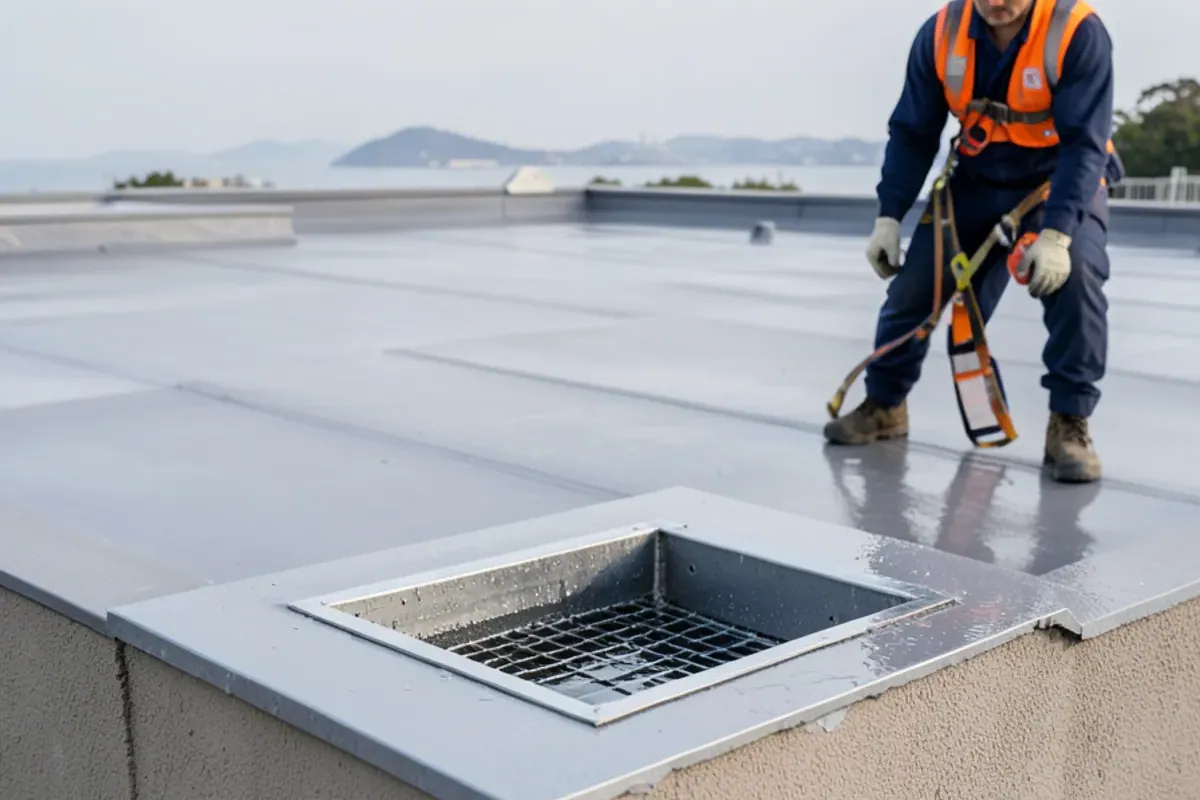
Flat roofs on the island include townhouse roofs, additions and bulkhead tops, and leaks tend to start where a drain or wall meets the membrane. Our work has included a townhouse flat roof and bulkhead replacement in Alameda. On another Alameda job, aged decking was found at tear-off and explained to the customer as a change order before work moved on. That is the usual cost of a late repair: the membrane is the visible part, and the deck is the part that decides the budget.
What does a simple yearly flat roof routine look like?
| When | What to do |
|---|---|
| Early fall | Clear drains, scuppers and gutters; photograph seams and flashing |
| After the first heavy storm | Look for standing water and note how long it stays |
| Late winter | Recheck drains, look for new blisters, cracks or lifted edges |
| Spring | Repeat the fall check and compare photos with last year |
| After any trade visits the roof (satellite, HVAC, solar) | Look for punctures where the work was done |
Keep the photos in one folder with dates. When a roofer visits, the log shows how quickly a spot has changed. Anyone who adds a vent, antenna or air conditioner on the roof should tell you first, because every new penetration is a new place for water to get in.
Should you walk the roof, and what does repair versus replacement cost?
Stay off unless you have a safe way up and the roof is built to be walked. The California contractors' board says the best way to preserve a roof is to stay off it, and NRCA advises that homeowners without experience skip it. Foot traffic also scuffs membranes and drives grit into seams.
On cost, a 2026 Alameda pricing data set puts flat or built-up roofs at roughly $6,000 to $18,000 for a replacement. Patches and seam repairs run far less, and the size, access and layers decide the figure. Your written estimate is the number to hold anyone to. For the full picture of options, the flat roofing overview covers systems and repairs.
If the drains are clear but water still stands, or you find a soft spot, call us or ask for a free estimate and we will take a look at the roof.