
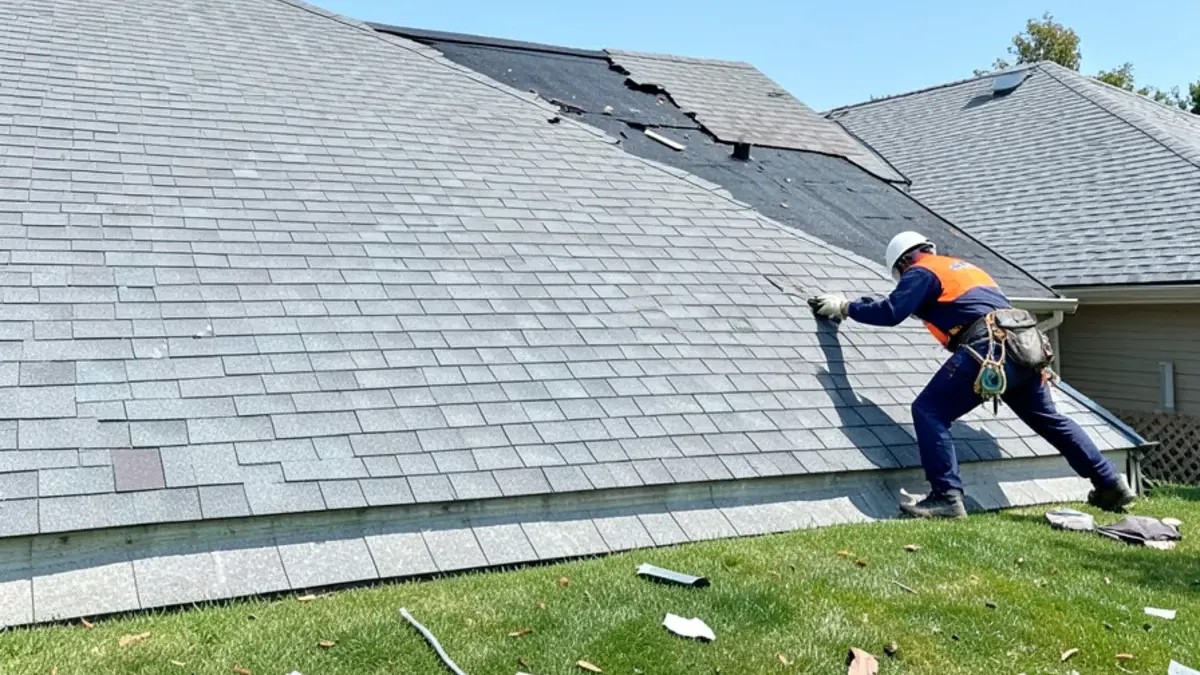
When shingles blew off your roof, do four things in order: look from the ground, photograph the damage, cover any opening before the next rain, and report the loss to your insurer. Do not climb up to check. Most wind damage is visible from the yard, and the roof is a poor place to be after a storm.
How can you check for wind damage from the ground?
Walk the whole property in daylight and look for three things: shingle pieces in the yard, bare or dark patches on the roof, and lines of lifted or curled edges. Use binoculars or the zoom on your phone camera.
Wind rarely hits evenly. It tends to lift the edges first, then the ridge and hips, then the corners of the slope that faces the weather. These are the signs to look for:
| What you see | What it usually means |
|---|---|
| Shingle pieces on the lawn | Tabs broke off or whole shingles tore free |
| Dark bare patch | Shingles gone, underlayment exposed |
| Missing ridge cap | Top edge open to rain and wind |
| Lifted or curled edges | Sealant strip failed, more loss likely |
| Granules in gutters | Surface wear, possibly pre-existing |
| Exposed nail heads | Shingle layer above is gone |
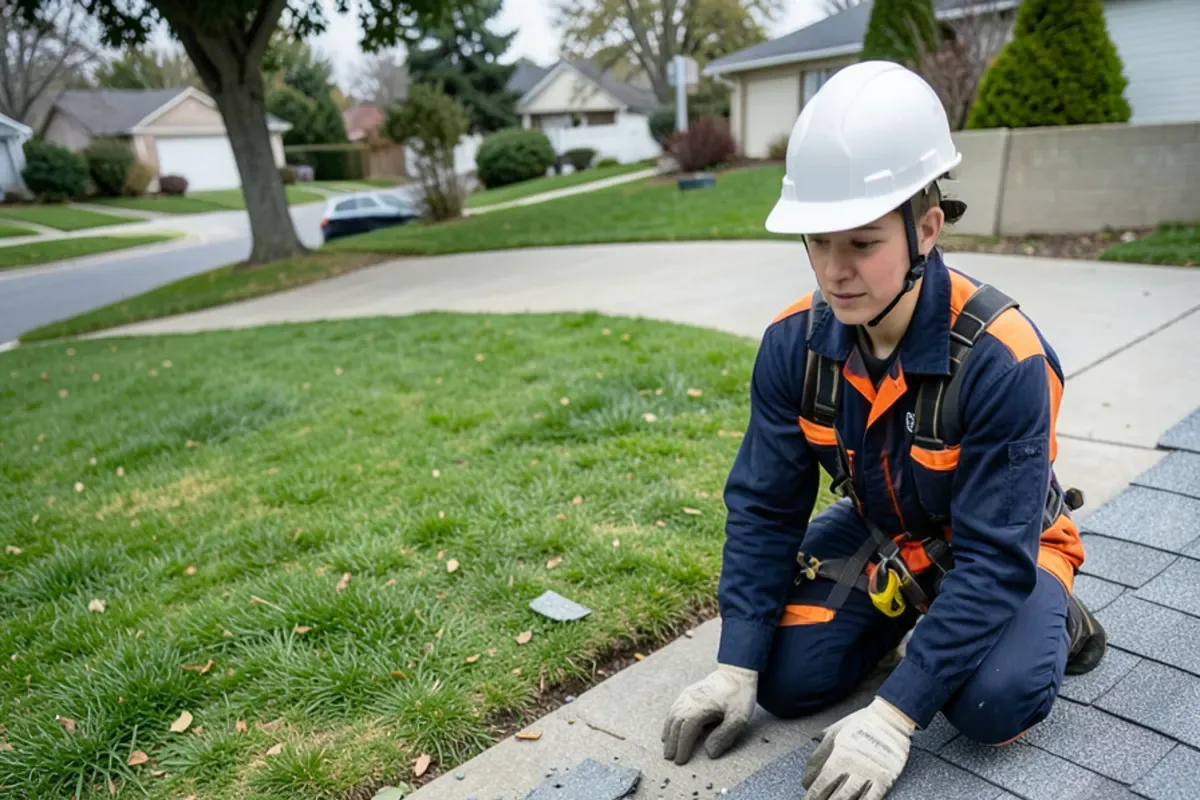
Check the neighbors' roofs and your fences and trees, too. Photos of debris on the ground help show that wind caused the loss.
What should you photograph for the claim?
Photograph before anything is moved or covered. Take wide shots that show the whole roof and its position on the house, then close-ups of each missing area. Include the date on your phone, the weather report for the day if you can find it, and photos of any water stains that appear inside.
Keep the shingle pieces from the yard in a pile, and do not throw anything away until the adjuster says it is all right. The California Department of Insurance says to keep a log of calls and correspondence and to take pictures of the damage. Write down who you spoke with and when.
Why cover the opening right away?
Bare underlayment is not a roof. It is a temporary water barrier that tears and leaks, and wind that took the shingles will shake it as well. The California Department of Insurance tells owners to make temporary repairs, keep receipts, and hold off on extensive permanent repairs until the adjuster has inspected. Policies may not cover further damage if you do not take reasonable steps to prevent it.
A tarp must be anchored to solid framing, not tacked down. A proper cover wraps the tarp edge around wood battens screwed into the framing. OSHA sets six feet above a lower level as the height at which workers need conventional fall protection, so a ridge repair is not a ladder job for a homeowner.
Which shingles fail first, and why?
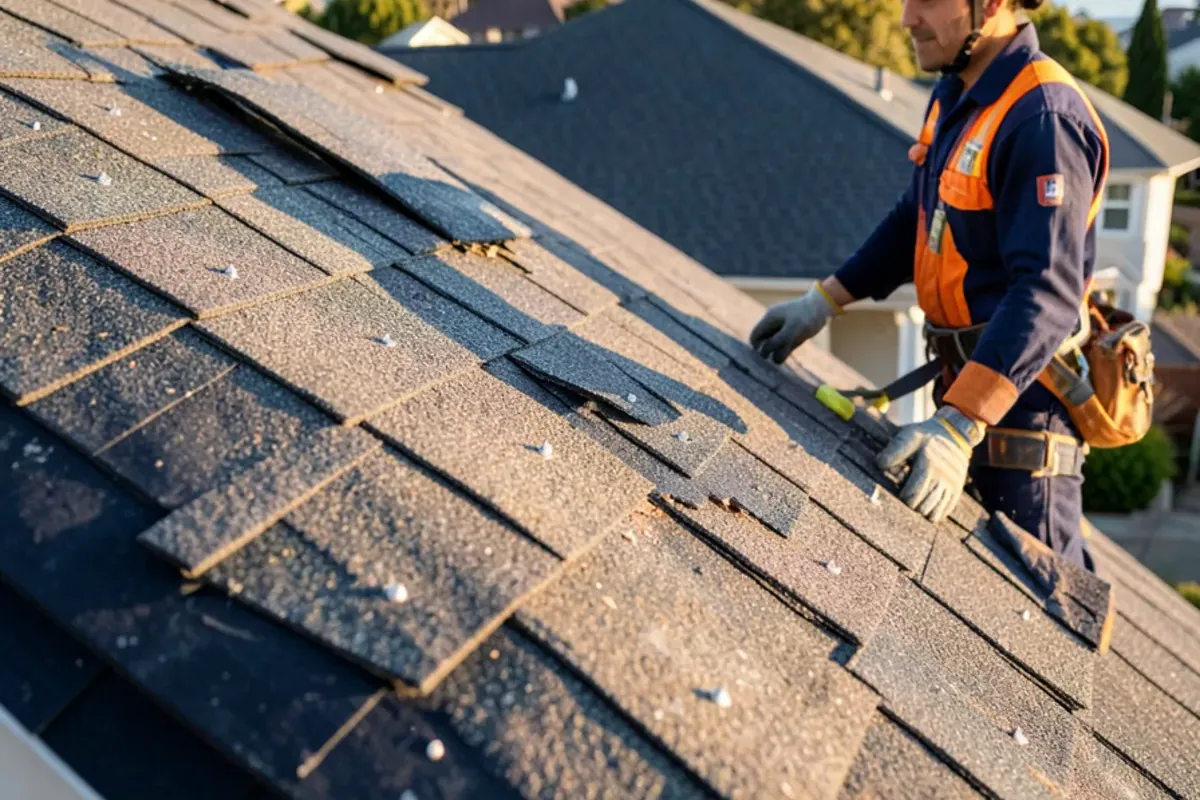
Wind starts at the edges and works inward. Shingles stay down by nails and by a factory sealant strip that bonds each tab to the course below. When that bond ages, dries or never sealed properly, wind gets under the tab and creases it, and the creased tab breaks off. That is why damage clusters at eaves, rakes, ridges and hips, and on the slope facing the wind.
Age matters more than most owners expect. A roof with tired sealant loses tabs in moderate gusts, while a younger roof with good bonds can ride out the same wind. Three trade-offs follow from that:
- A fresh repair next to old shingles is only as strong as the old shingles around it
- Hand-sealing the tabs near a repair with manufacturer-approved cement adds a measure of protection
- Replacing a whole slope may cost more but ends the cycle if the sealant bond is gone everywhere
Roofing trade sources describe the ASTM D3161 fan test with Class A at 60 mph, Class D at 90 mph and Class F at 110 mph. If you replace the roof, ask which class the shingle carries. The rating tells you how the product tested, not how the installation will perform.
Repair or replace after wind damage?
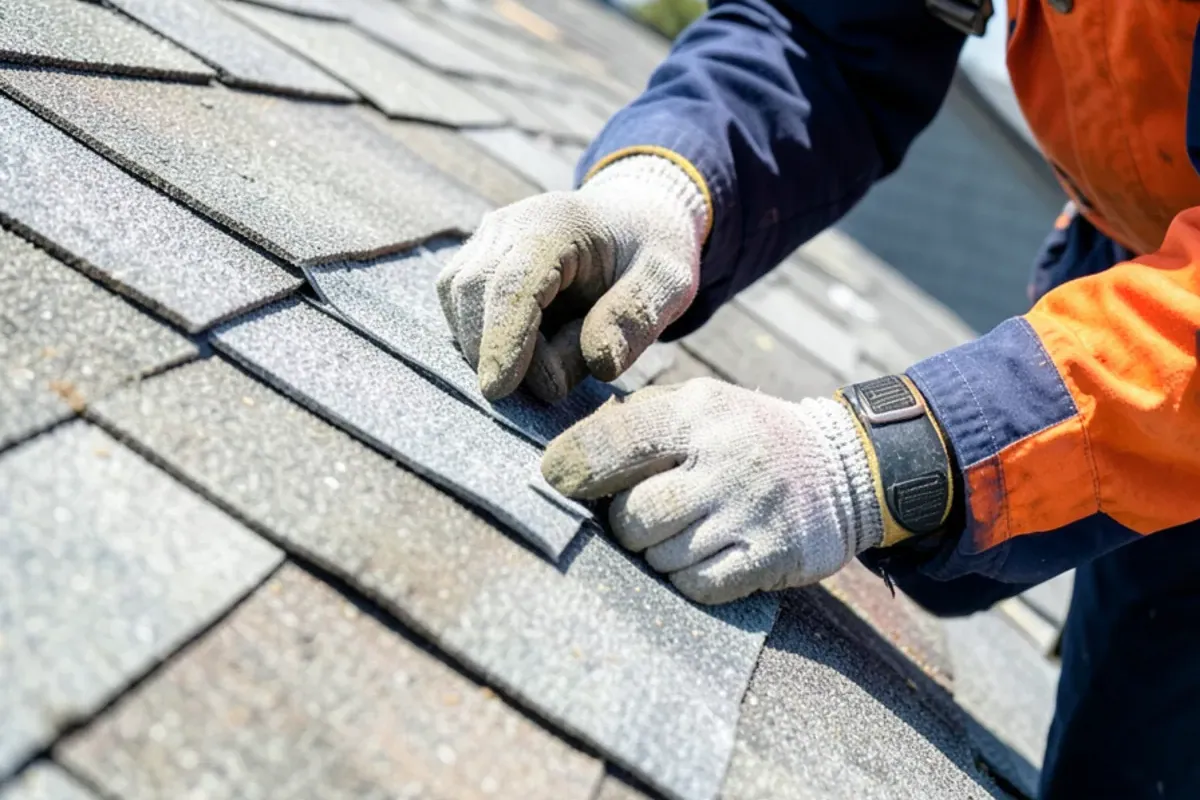
A repair is right when damage is local and the rest of the roof is sound. Replacement is right when brittle, curled or unsealed shingles cover most of a slope, or when the roof is near the end of its life. A roofer can tell you which from the nail pattern, the underlayment and a hand test of the surrounding tabs.
| Condition | Usual path |
|---|---|
| Few shingles missing, rest sealed and flexible | Repair, with matching shingles |
| Ridge cap gone, field shingles sound | Replace the ridge cap and underlayment |
| One slope heavily lifted or creased | Replace that slope or discuss full replacement |
| Roof already has two layers | Tear-off, since California bars covering a roof with two or more applications |
| Old roof, brittle tabs, repairs repeating | Full replacement estimate |
The written estimate should say which one it is pricing, and why, so you and the adjuster are comparing the same scope. Our wind damage roof repair page explains how a partial repair is scoped.
How does the insurance clock work after wind damage?
Report the loss promptly, then follow the timeline California sets for insurers. Under Title 10 of the California Code of Regulations, an insurer must acknowledge a claim and begin investigating within 15 calendar days, and must accept or deny it, in whole or in part, within 40 calendar days after receiving proof of claim. If it needs more time, it has to explain in writing and update you every 30 days. Once a claim is accepted, the insurer has 30 calendar days to pay.
Wind that tears shingles off a sound roof is a sudden event, which policies often treat differently from slow wear. A roof at the end of its life can lead to a denial based on wear and tear, so the roof age and condition matter. Read your own policy, and ask the adjuster to name the provision for any exclusion. The California Department of Insurance consumer line is 1-800-927-4357.
On a claim, our part is the photos, the repair scope and the on-site walk with the adjuster. Negotiating is not ours to do, since California limits that to the policyholder, the insurer or a licensed public adjuster.
What wind calls look like in Alameda and nearby
Past Alameda customers describe wind jobs as quick to start. One said a crew stopped by the same day after a windstorm and tarped lost ridge shingles. Another reported a visit within 24 hours of a windstorm to waterproof the roof. After strong wind, a loose shingle on one roof was replaced under the workmanship warranty, and that customer had received the warranty paperwork and details. These are customer accounts, not a promise on timing or terms, and the warranty terms go in your contract in writing. Ask us before you sign.
Partial repairs raise a matching question. On one job the closest shingle was tracked down and delivered for a partial repair.
San Leandro is covered too, about 24 minutes from our Webster St office in typical traffic, and its post-war neighborhoods have many roofs that are well beyond their first installation. The wider storm damage hub, storm damage roofing, covers other wind and tree jobs, and our wind damage page covers what a repair visit includes, and roof insurance claims explains how we document the roof for an adjuster. Alameda homeowners can also begin at the home page.
If shingles are missing now, call the office and describe the roof, or ask for a free inspection and estimate. Send the photos you took, since they let us plan the visit.