

How do you find where a roof is leaking?
Start in the attic, not on the roof. Trace the stain uphill and sideways until you find wet wood, stained sheathing or a trail along a rafter, then match that spot to what sits above it on the roof: a vent pipe, a chimney, a wall junction, a valley or a skylight. The ceiling stain shows where the water ended up. The roof opening is almost always higher up the slope and often offset to one side.
The method below works for most leaks on a composition shingle roof. If the roof is steep, wet or two stories, stay on the ground and use it as a checklist for what to tell the roofer.
What does the ceiling stain tell you?
A ceiling stain gives a starting point and a time clue. Brown rings with soft edges that grow after each rain point to a slow, repeating leak. A fresh, wet, dripping spot points to something that opened recently, such as a lifted shingle after wind. A stain that appears on cold mornings with no rain is more likely condensation than a roof hole.
Check these first:
- Is the stain directly below a bath fan, vent pipe or light fixture?
- Does it grow only in heavy rain, or in light drizzle too?
- Is it near an exterior wall, chimney or skylight shaft?
- Is the insulation above it matted, dark or wet?
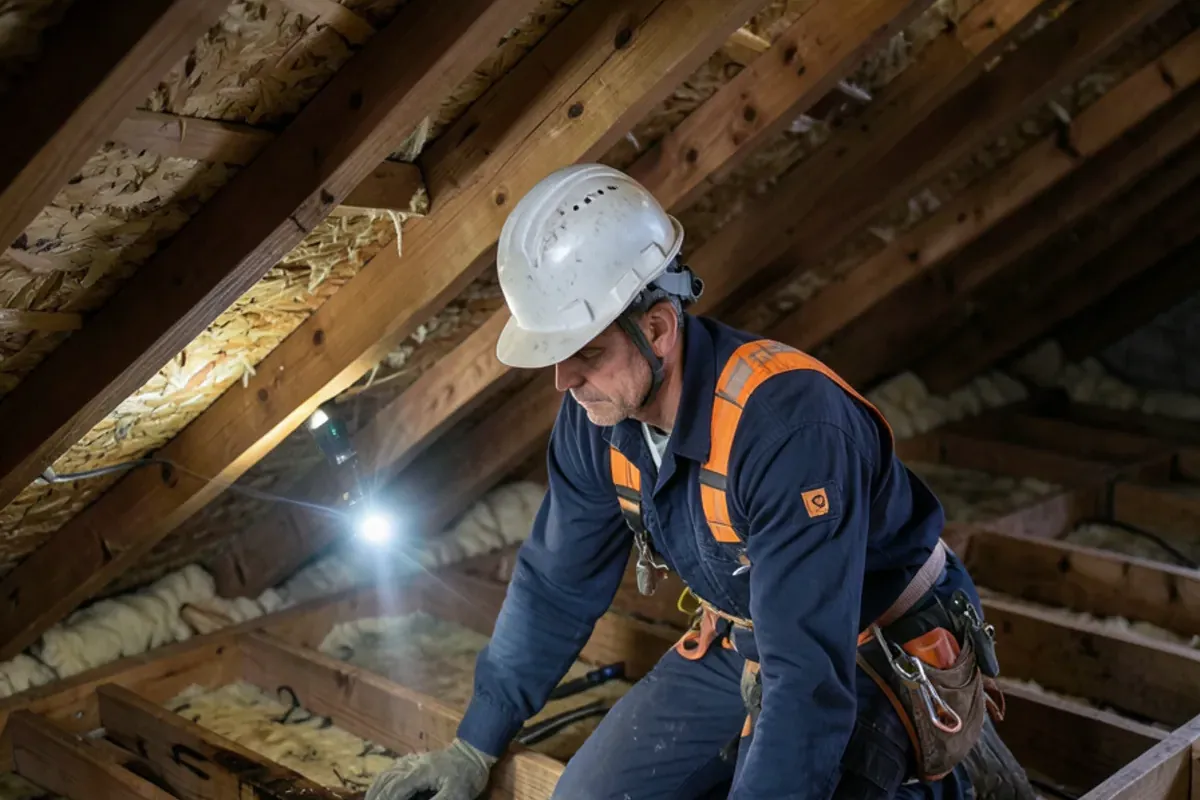
How to check the attic for a leak
Go up in daylight with a flashlight, right after rain if you can. Step only on the joists and never on the drywall between them. Then work through this list:
- Look at the underside of the sheathing above the stain for dark streaks, rust on nail tips or a wet patch
- Follow any streak uphill along the rafter to its highest point
- Check insulation for compressed or discolored areas
- Look around each pipe, chimney and skylight for daylight, which marks an open seam
- Photograph what you find with a ruler in the frame
Take the photos even if you cannot read the clues. A roofer can often tell the cause in a minute from a good picture.
What does each ceiling-stain clue point to?
Match what you see to the likely source, then confirm it in the attic. These are tendencies, not diagnoses:
| What you see | Likely source | Check first |
|---|---|---|
| Round stain, grows slowly after each rain | Vent pipe boot or nail pop | Plumbing and exhaust vents above the stain |
| Stain along an outside wall | Step flashing, gutter overflow or fascia | Wall junction and gutter line outside |
| Long streak running down a wall | Chimney or sidewall flashing | Counterflashing and mortar joints |
| Stain beside a skylight shaft | Skylight flashing or curb seal | Corners and the upper edge of the unit |
| Appears only in wind-driven rain | Lifted shingles, ridge or windward flashing | Windward slope and ridge |
| Appears on cold dry mornings | Condensation, not the roof | Bath fan and attic ventilation |
Where do roof leaks usually start?
Most leaks start at a roof penetration or junction, not in the open field of shingles. The usual suspects:
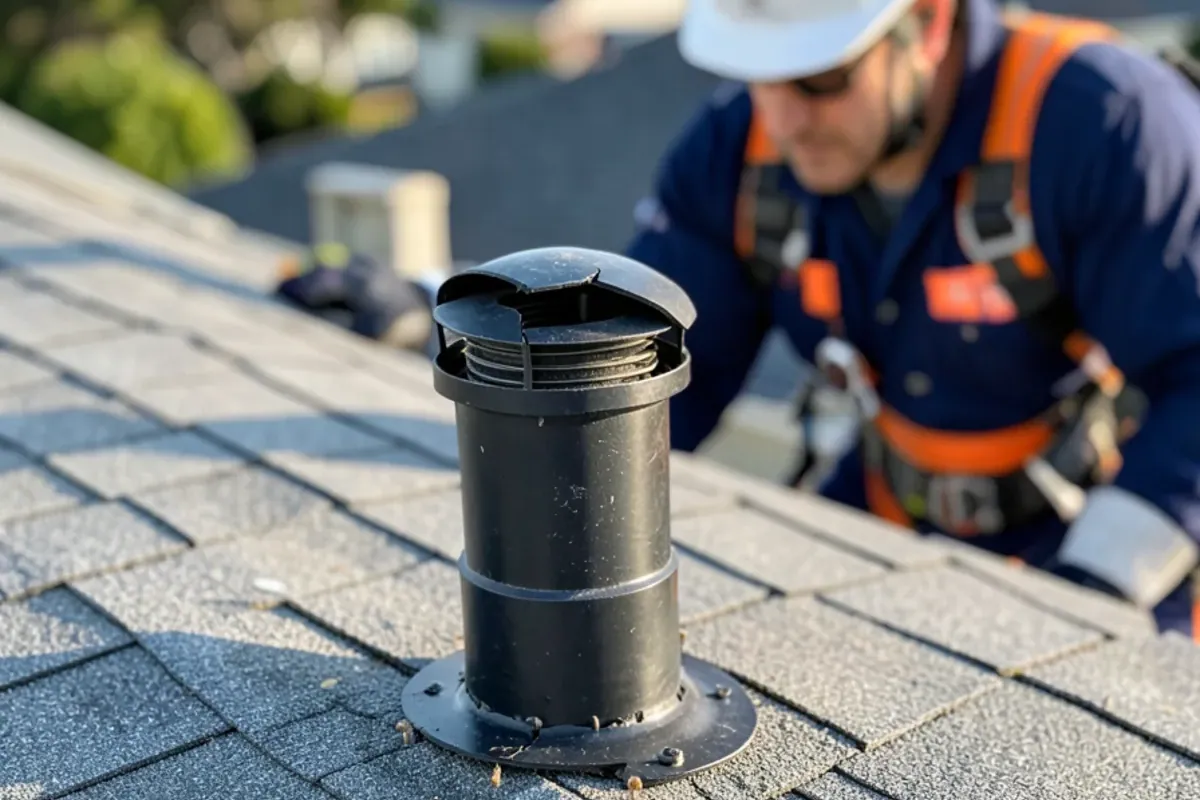
Vent pipe boots. The rubber collar around a plumbing vent cracks in the sun and lets water run down the pipe. It is a small, cheap part that causes a lot of stains.
Flashing at walls and chimneys. Metal that lifts, rusts or relies on old caulk lets water behind the shingles.
Valleys. Where two slopes meet, water volume is high and one worn spot is enough.
Skylights. Failed flashing or a sealed edge that has aged. See skylight repair before assuming the unit must be replaced.
Lost or lifted shingles. Strong wind can lift tabs and pull off ridge pieces.
Gutters and eaves. Overflowing gutters push water behind the fascia and into the soffit, which can show up as a ceiling stain along an outside wall.
Should you do a water test?
A water test finds leaks that dry-weather inspection misses, but it needs two people and a plan. One person runs a hose on a small section of roof, starting at the lowest point and working up. The other watches the attic. Spray one area for about ten minutes before moving uphill, so you know which zone caused the drip.
Do not run the hose on a roof you cannot see safely. If the first test finds nothing, stop and call a roofer. Soaking the whole roof can make the problem harder to read.
How does a roofer narrow down a leak?
A roofer works from the inside out, then confirms from above. The attic gives the wet zone. The roof surface gives the cause. The method is simple, and the order is what makes it reliable:
- Mark the wet zone in the attic, then measure its distance from a fixed point such as a chimney or a vent pipe
- Walk to the matching spot on the roof and check every penetration within a few feet uphill
- Look for exposed nails, cracked sealant, lifted flashing and worn granules in the shingle field
- Test the suspect with water only if the visual check leaves two candidates
The trade-off is between a quick seal and a real repair. Roof cement smeared over a suspect spot can stop a drip for a season and hide the true entry point. It also makes later flashing work harder, because new metal has to be fitted over old tar. Resealing is fair when the flashing is sound and only the sealant failed. When the metal is bent or rusted, replacing it is the repair that lasts. For more on that split, see roof flashing repair.

What should you do while you wait for a roofer?
Stop the water inside first, then protect the evidence. Set a bucket, move furniture and electronics, and lay towels. Photograph the stain, the attic wood and the roof from the ground with a date on the shot. Stay off a wet roof. A roofer can tarp or seal the entry point as a temporary measure, which also keeps the damage on record for a claim. Keep any receipts.
What we see on leak calls in Alameda
A leak that looks like a roof problem is sometimes a skylight problem, and the reverse. Pedro once sealed a small skylight leak from the truck before the customer had even hired the company. On another job, a customer called about a skylight leak that began after a different roofer's reroof. Several customers report a same-day reply to a leak call, with a fast inspection.
We also see old flashing and gutter faults left by previous work. Those get fixed in the same visit when the roofer finds them.
What matters is documenting the leak before it dries. Photograph the stain, the attic wood and any exterior suspects, then send them with your call.
When should you call a roofer?
Call when the leak returns after a dry fix, when you find wet insulation, when the roof is steep or when you see daylight at a penetration. For Berkeley homeowners, we cover the area from our Webster St office in Alameda, roughly 18 minutes away outside peak traffic, and the same steps apply to older roofs there. See Berkeley for coverage, roof leak repair for what a repair visit includes, and the wider roof repair section for related fixes. Alameda owners start from the home page.
Call the office, describe the stain, and ask for a free inspection.